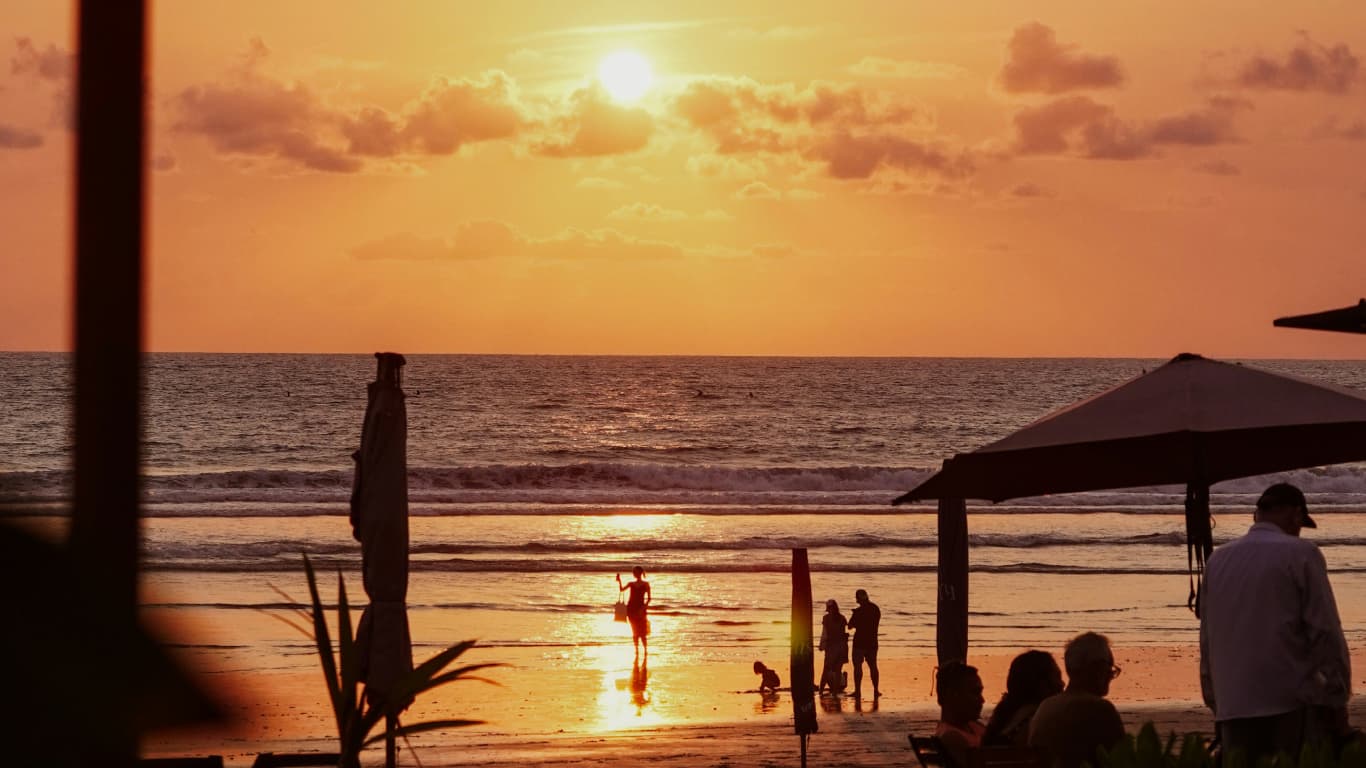
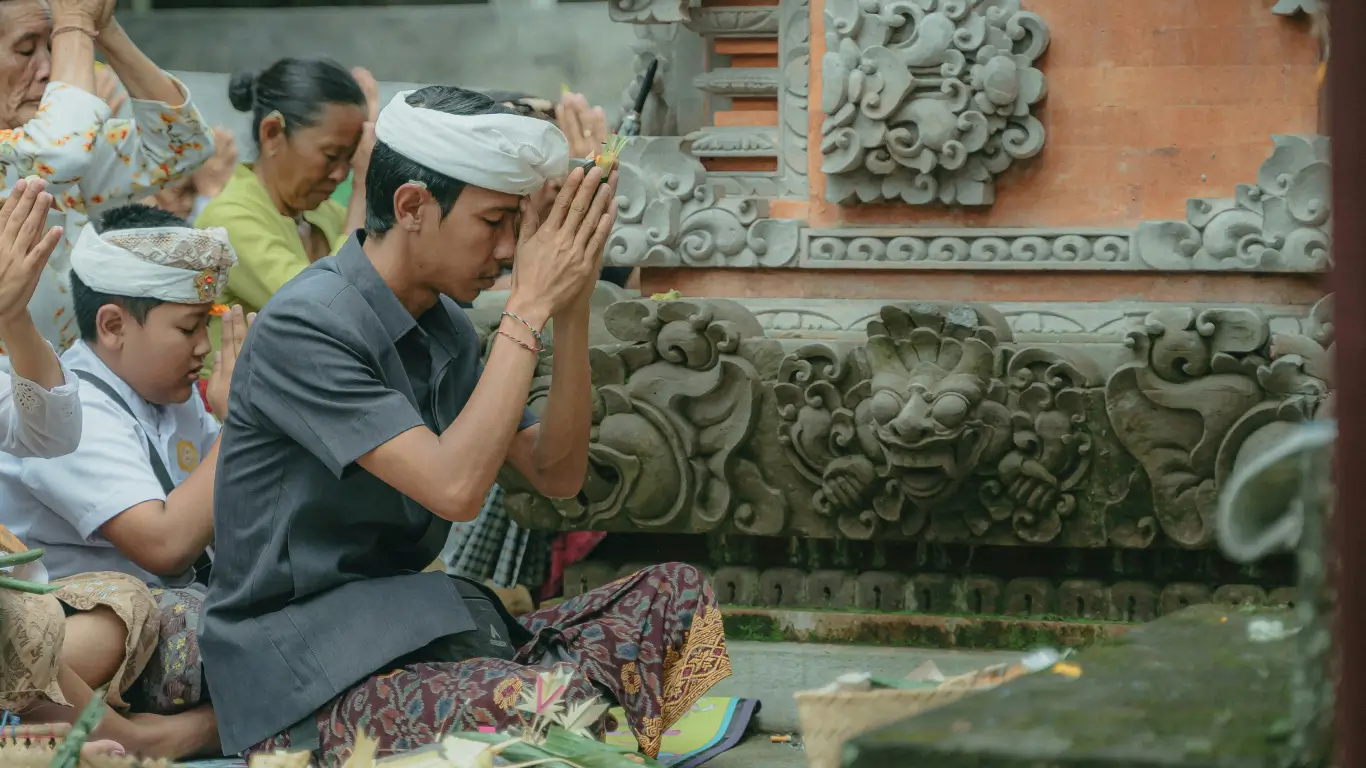
Bali's calendar is full of ceremonies, and few are as quietly beautiful as Hari Raya Saraswati, the day the island honors Dewi Saraswati, the Hindu goddess of knowledge, music, art, and wisdom. Books are blessed, students dress in traditional attire for prayers, and offerings appear in classrooms, offices, and family shrines.
In 2026, Saraswati Day falls twice: Saturday, 4 April and Saturday, 31 October. Here is what the day means, what you will see, and how to experience it respectfully as a visitor.
Dedicated to Dewi Saraswati, the goddess of knowledge and arts, Saraswati Day is celebrated on a Saturday roughly twice a year under Bali's 210-day Pawukon calendar, falling on 4 April and 31 October in 2026. The sacred day centers on blessing books and manuscripts with holy water and offerings, followed on Sunday by dawn purification rituals known as Banyu Pinaruh at local beaches, rivers, and holy springs. Visitors are welcome to observe the festivities respectfully by dressing modestly, maintaining distance during ceremonies, and asking for permission before taking photos.
Saraswati Day Dates in 2026
Because Saraswati Day follows the 210-day Pawukon calendar rather than the 365-day Gregorian one, it lands on different dates each year and occurs about twice a year. Several related holy days follow in sequence, which is useful to know if you are planning around them.
| Holy day | April cycle | October cycle |
| Saraswati Day | Saturday, 4 April 2026 | Saturday, 31 October 2026 |
| Banyu Pinaruh | Sunday, 5 April 2026 | Sunday, 1 November 2026 |
| Soma Ribek | Monday, 6 April 2026 | Monday, 2 November 2026 |
| Sabuh Mas | Tuesday, 7 April 2026 | Tuesday, 3 November 2026 |
| Pagerwesi | Wednesday, 8 April 2026 | Wednesday, 4 November 2026 |
By the same 210-day count, the next Saraswati Day after 31 October 2026 falls on 29 May 2027. Check a current Balinese calendar before planning, as dates are published each year.
What Is Saraswati Day?
Hari Raya Saraswati is a pivotal day in the Pawukon calendar, a cycle of 210 days made up of 30 weeks called wuku, each lasting seven days. Saraswati Day always falls on a Saturday (Saniscara), on Umanis in the final wuku, Watugunung, which makes it the last day of the entire cycle.
That placement is the point. The Balinese mark the end of one cycle by honoring knowledge itself, before the calendar starts again the next day with Banyu Pinaruh. Local tradition links this turning point to the myth of King Watugunung, who became the guardian of the calendar's final week.
For Balinese Hindus, Saraswati Day is especially meaningful to students, teachers, lecturers, and anyone whose work depends on learning. It is a day to give thanks for the knowledge received and to ask for clarity in the cycle ahead.
Who Is Dewi Saraswati?
Dewi Saraswati is the consort of Brahma, the creator, and is revered as the source of knowledge, creativity, and learning, from sacred scriptures to modern science. She is usually shown as a graceful woman in white, seated on a lotus, which symbolizes purity and supreme knowledge.
The symbols around her each carry meaning:
- A lontar (palm-leaf manuscript): knowledge itself
- A veena (stringed instrument): the arts, and knowledge developing through culture
- A genitri (rosary beads): meditation and spiritual practice, and knowledge that never ends
- A swan (hamsa): traditionally said to separate milk from water, symbolizing the wisdom to tell truth from falsehood
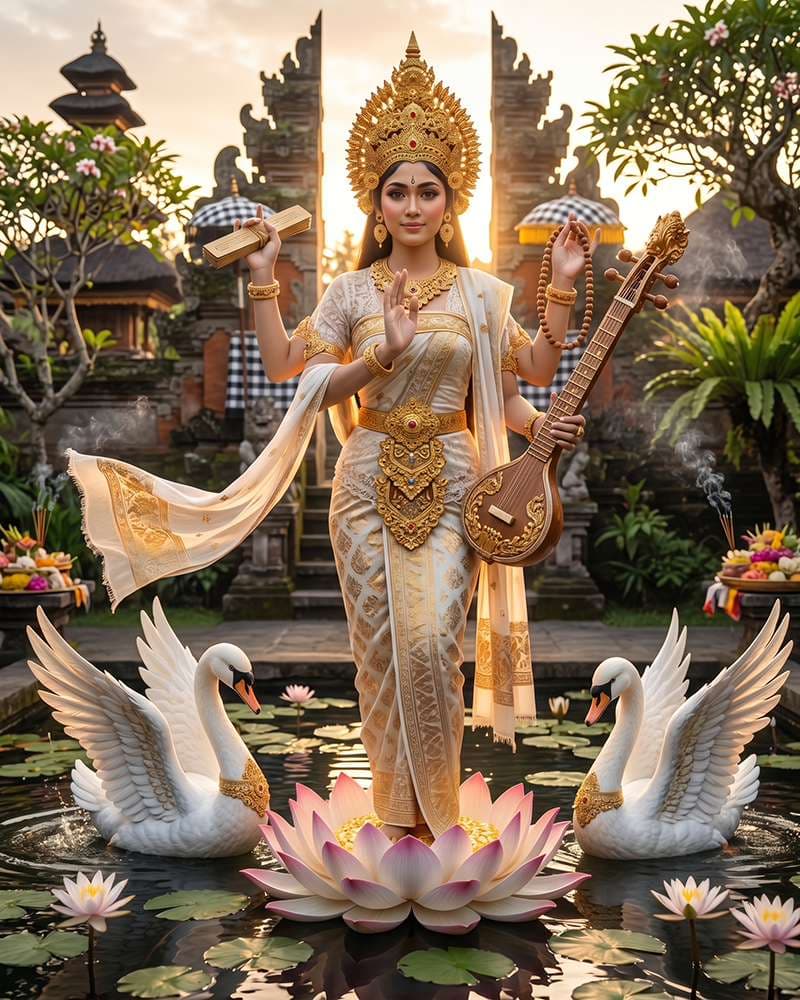
Her four arms are often read as the four faculties of the mind: manas (mind), buddhi (intellect), citta (consciousness), and ahamkara (ego).
What Happens on Saraswati Day
The day begins early, and you will notice it even if you are not looking for it.
Blessing books and manuscripts. The central ritual is giving thanks for sources of knowledge. Families gather books, lontar manuscripts, and, in modern households, even laptops and place them on a special altar. A priest or family elder sprinkles them with holy water (tirta) and presents offerings called banten.
Prayers at schools, temples, and homes. Schools and universities become ceremony sites. Students in traditional attire (pakaian adat) bring offerings to the school temple, and the air fills with incense and chanting. Offices and family shrines hold their own prayers, and worship traditionally takes place in the morning and afternoon.
A day of rest for books. Books and lontar are presented as offerings, so in many households they are set aside and not used for the rest of the day. The idea is that knowledge is being sanctified rather than consumed. How strictly this is observed varies from family to family.
The Day After: Banyu Pinaruh
The spiritual journey continues on Sunday with Banyu Pinaruh. The name combines banyu (water) and pinaruh (knowledge), and it also marks the start of a new Pawukon cycle.
Early in the morning, Balinese Hindus go to the sea, rivers, lakes, waterfalls, and holy springs to bathe and perform purification, often as part of the melukat tradition. They leave small canang sari offerings by the water as thanks to Saraswati. Symbolically, the water washes away ignorance and impurity so that the knowledge blessed the day before can settle into a clear mind.
Beaches and sites named in connection with Banyu Pinaruh include Sanur, Kuta, Melasti, and Pandawa, as well as Tirta Empul, the holy spring temple in Tampaksiring. These are places of prayer, not sightseeing spots, so keep a respectful distance.
Where to Witness Saraswati Day
Ceremonies happen in every Balinese Hindu household, but some of the most visible celebrations are public:
- Schools and campuses: the largest and most colorful ceremonies, with students in full traditional dress. Visitors generally cannot walk in uninvited, so ask first.
- Public temples: major temples such as Pura Jagatnatha in Denpasar hold public prayers.
- Villages and neighborhoods: simply walking or riding through a village, you will see offerings outside homes, shops, and offices.
- Your hotel: many hotels in Bali prepare offerings or can tell you where nearby ceremonies are taking place.
How to Be a Respectful Visitor
Saraswati Day is a religious observance, not a performance. A few habits go a long way:
- Dress modestly. Wear a sarong and sash if you go near a temple or ceremony.
- Keep your distance. Observe from the side and never walk in front of someone who is praying.
- Ask before photographing. Do not photograph people praying at close range, and never use flash or drones near a ceremony.
- Do not enter ceremonies uninvited. If a family or school invites you, accept graciously and follow their lead.
- Be flexible. Some local businesses and services may run on a different schedule, so avoid packing your day too tightly.
Frequently Asked Questions
When is Saraswati Day in Bali in 2026? Saraswati Day falls on Saturday, 4 April 2026 and again on Saturday, 31 October 2026.
Why does Saraswati Day happen twice a year? It follows Bali's 210-day Pawukon calendar rather than the 365-day Gregorian calendar, so it occurs every 210 days, about twice a year, and shifts to different dates each year.
What is Saraswati Day for? It honors Dewi Saraswati, the Hindu goddess of knowledge, art, music, and wisdom. Balinese Hindus bless their books and manuscripts, give thanks for knowledge, and pray for clarity and understanding.
What is Banyu Pinaruh? Banyu Pinaruh is the water purification ritual held the morning after Saraswati Day. Devotees bathe at beaches, rivers, and holy springs to symbolically wash away ignorance and welcome wisdom.
Can tourists attend Saraswati Day ceremonies? Visitors can observe respectfully, especially in public places, but should not enter ceremonies uninvited. Wear a sarong and sash, keep your distance, and ask before taking photos.
Can you read or write on Saraswati Day? Traditionally, books and lontar manuscripts are offered to the goddess and set aside rather than used on the day, but observance varies between families and communities.
Does Saraswati Day close businesses in Bali? No. Unlike Nyepi, Saraswati Day is not an island-wide shutdown, though ceremonies mean some schools and local businesses operate differently, so check ahead if you have plans.
What comes after Saraswati Day? Banyu Pinaruh follows on Sunday, then Soma Ribek, Sabuh Mas, and Pagerwesi on Wednesday, the day known as the "iron fence."
Planning a trip around Bali's ceremonies? Staying at Rimbun Canggu Hotel puts you in a good spot to experience local culture at a gentle pace. For the practical basics before you go, see our guide to your first time in Canggu.