A few days after Bali celebrates knowledge on Saraswati Day, the island turns to a second, quieter question: how do you protect what you have learned? The answer is Hari Raya Pagerwesi, the "Iron Fence" day, devoted to strengthening the mind and spirit against negative influences.
In 2026, Pagerwesi falls twice: Wednesday, 8 April and Wednesday, 4 November. Here is what the day means, how it is observed, and how to experience it respectfully as a visitor.
Translating to "Iron Fence," Pagerwesi is a day of spiritual fortification dedicated to Sang Hyang Pramesti Guru, observed four days after Saraswati Day on 8 April and 4 November in 2026. While Saraswati marks the receiving of knowledge, Pagerwesi centers on protecting and grounding that wisdom against negative influences. Celebrations range from grand Galungan-scale festivities in Buleleng to intimate household rituals in southern Bali, and visitors are welcome to observe by dressing modestly, keeping a respectful distance, and asking permission before taking photos.
Pagerwesi Dates in 2026
Pagerwesi follows Bali's 210-day Pawukon calendar rather than the Gregorian one, so it lands on different dates each year. It is the last in a run of holy days that begins with Saraswati Day, which makes the dates easy to plan around once you know one of them.
| Holy day | April cycle | November cycle |
| Saraswati Day | Saturday, 4 April 2026 | Saturday, 31 October 2026 |
| Banyu Pinaruh | Sunday, 5 April 2026 | Sunday, 1 November 2026 |
| Soma Ribek | Monday, 6 April 2026 | Monday, 2 November 2026 |
| Sabuh Mas | Tuesday, 7 April 2026 | Tuesday, 3 November 2026 |
| Pagerwesi | Wednesday, 8 April 2026 | Wednesday, 4 November 2026 |
By the same 210-day count, the next Pagerwesi after 4 November 2026 falls on 2 June 2027. Check a current Balinese calendar before planning, as dates are published each year.
The Meaning of Pagerwesi: The Iron Fence
The name combines two Balinese words: pager, meaning "fence," and wesi, meaning "iron." Together they describe a strong, unbreakable boundary, a metaphor for protecting oneself with knowledge and wisdom against negative influences and the pull of adharma, or wrongdoing.
Balinese Hindus often describe the day through four ideas: self-protection, reflection and meditation, purity and wisdom, and harmony and prosperity. It is less about fear than about steadiness, building the inner strength to keep your mind clear when life tests it.
Saraswati and Pagerwesi: Receiving Knowledge, Then Protecting It
The two holy days belong together, and the logic of the calendar makes the link clear:
- Saraswati Day is when knowledge, art, and wisdom are received. It is a day of learning and gratitude. Read the full story in our guide to Saraswati Day in Bali.
- Pagerwesi is when that knowledge is guarded, so it is not lost, misused, or corrupted.
If Saraswati Day fills the cup of knowledge, Pagerwesi protects the cup from being shattered. Between them come Banyu Pinaruh, the dawn purification ritual on Sunday, and the smaller observances of Soma Ribek and Sabuh Mas.
Who Is Sang Hyang Pramesti Guru?
On Pagerwesi, Balinese Hindus honor Sang Hyang Widhi Wasa, the Supreme God, in the manifestation of Sang Hyang Pramesti Guru. He is the divine teacher and protector of the universe, regarded as a manifestation of Lord Shiva. As the ultimate guru, he is the source of the wisdom needed to build a spiritual defense, and worshippers ask him for strength, protection, and guidance.
Because the day centers on the idea of a divine teacher, it is also a natural moment to reflect on the people who have guided you in life.
Rituals and Traditions
Pagerwesi is observed with solemnity and devotion across the island, though the style varies from region to region.
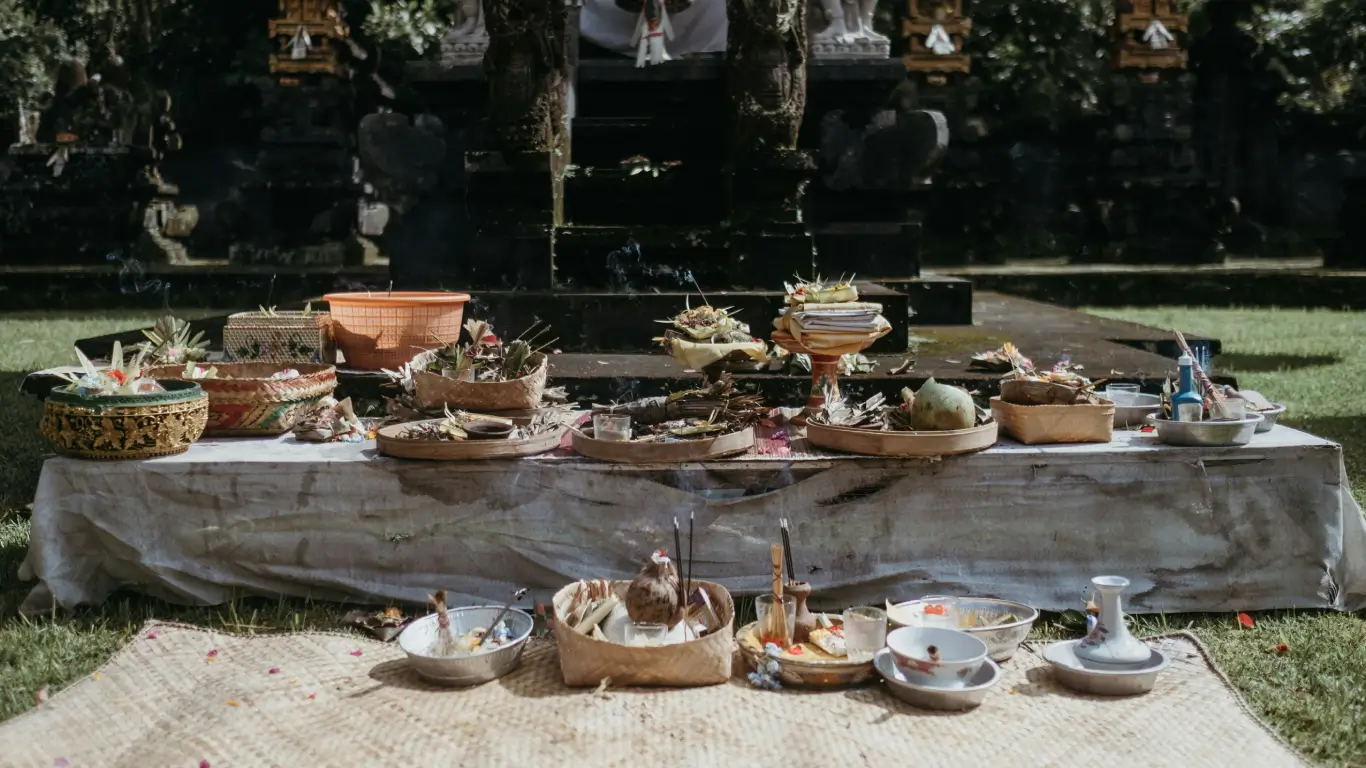
Offerings and family prayers. The day begins at home. Families prepare offerings (banten) and pray at their family shrine (sanggah or merajan), then continue to the extended family temple and the village temple for communal prayers. Dressed in ceremonial attire, whole families make the rounds together.
Prayer, meditation, and reflection. The focus is inward: self-reflection, meditation, and renewing faith. Some accounts describe Pagerwesi as unusual among Balinese ceremonies for being observed at night, so you may notice prayers continuing into the evening.
Penjor and decorations. In some communities, tall decorated bamboo poles (penjor) appear around temple grounds in the lead-up to the day.
The Days Before Pagerwesi
Two smaller observances come first. Soma Ribek, on the Monday, honors Bhatari Sri, the goddess of rice and abundance, with offerings placed in a rice container. Sabuh Mas, on the Tuesday, is a day of prayers and offerings for prosperity in the year ahead.
How Pagerwesi Differs Across Bali
Pagerwesi does not look the same everywhere, and this is worth knowing as a traveler.
North Bali (Buleleng). Here, Pagerwesi is often called the "Galungan of North Bali," observed on a scale similar to Galungan. Families and neighbors gather the day before for Penampahan and prepare traditional dishes such as lawar. On Pagerwesi itself, many families practice Munjung ke Setra, bringing offerings to the cemetery to honor ancestors, praying, and sharing a meal there.
South Bali (Denpasar, Gianyar, and nearby). The mood is more private and solemn. Observance centers on family prayers at the home temple, without the communal feasting or cemetery visits seen in the north.
If you are staying in the south, including around Canggu, you will most likely notice offerings outside homes and families heading to temples in ceremonial dress, rather than large public festivities.
How to Be a Respectful Visitor
Visitors are generally welcome to observe from a respectful distance. A few habits make a real difference:
- Dress modestly. Wear a sarong and sash if you go near a temple or ceremony.
- Keep your distance. Stay clear of prayer areas and never walk in front of someone who is praying.
- Skip the flash. Do not use flash or drones near a ceremony, and ask before photographing people at prayer.
- Do not enter uninvited. If a family or community invites you, accept graciously and follow their lead.
- Plan flexibly. Pagerwesi is a religious observance, not an island-wide closure, but some local offices and businesses may adjust their hours, so check ahead if you have errands.
- Greet warmly. "Selamat Hari Raya Pagerwesi" is a thoughtful way to acknowledge the day.
Frequently Asked Questions
When is Pagerwesi in 2026? Pagerwesi falls on Wednesday, 8 April 2026 and again on Wednesday, 4 November 2026.
What does Pagerwesi mean? Pagerwesi means "Iron Fence," from pager (fence) and wesi (iron). It symbolizes protecting oneself with knowledge and wisdom against negative influences.
Who is honored on Pagerwesi? Balinese Hindus honor Sang Hyang Pramesti Guru, the divine teacher and a manifestation of Lord Shiva, asking for strength, wisdom, and protection.
How is Pagerwesi related to Saraswati Day? Saraswati Day is when knowledge is received, and Pagerwesi, four days later, is when that knowledge is protected. See our guide to Saraswati Day in Bali for the first half of the story.
Why does Pagerwesi happen twice a year? It follows Bali's 210-day Pawukon calendar rather than the 365-day Gregorian calendar, so it occurs about twice a year and shifts to different dates each year.
Can tourists attend Pagerwesi ceremonies? Visitors can observe respectfully, especially in public places, but should not enter ceremonies uninvited. Wear a sarong and sash, keep your distance, and ask before taking photos.
Is Pagerwesi celebrated the same way across Bali? No. In Buleleng it is observed on a scale similar to Galungan, with communal feasting and cemetery visits, while in southern Bali it tends to be a quieter, family-centered observance.
Does Pagerwesi close businesses in Bali? No. Unlike Nyepi, Pagerwesi is not an island-wide shutdown, though ceremonies mean some local businesses and offices may operate differently, so check ahead if you have plans.
Planning a trip around Bali's ceremonies? Rimbun Canggu Hotel is a calm base for experiencing local culture at a gentle pace. For the practical basics, start with our guide to your first time in Canggu, then plan your days with our 3 days in Canggu itinerary.