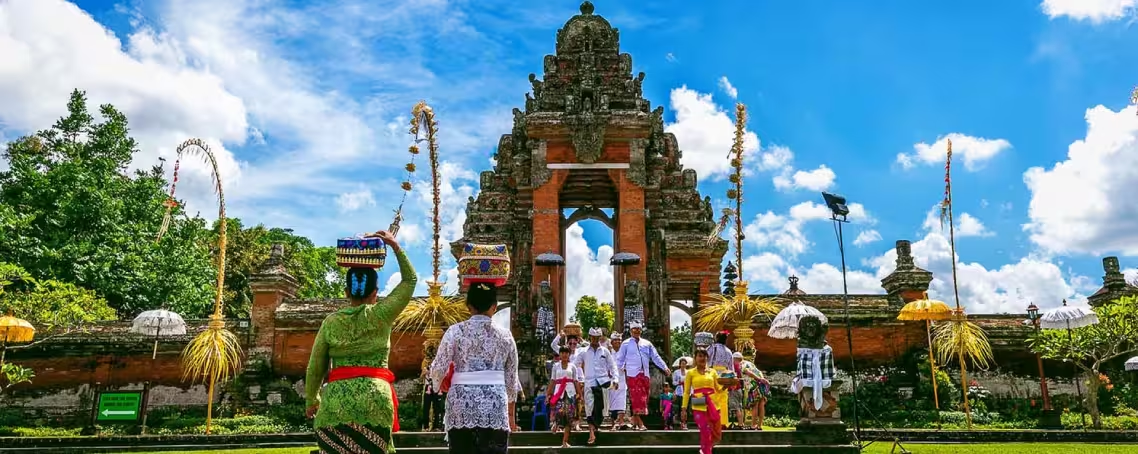
The incense has been burning since before dawn. On the family shrine, a carefully arranged tower of offerings gleams gold and yellow in the morning light — coconut leaves woven into precise geometric shapes, a small bag of provisions, a round shield-like disc, and at the center of it all, a mound of fragrant yellow rice. An elderly woman kneels in prayer, her white kebaya immaculate, her lips moving in silent devotion.
She is saying goodbye.
This is Kuningan Day — the most tender moment in Bali’s ceremonial calendar. Ten days ago, her ancestors arrived. Today, before the sun reaches its peak, they return to heaven. The yellow rice in the offering is their provision for the journey. The prayers are her love, carried upward.
For travelers fortunate enough to witness it, Kuningan offers something rarer than spectacle: a window into how an entire civilization relates to death, memory, and gratitude.
What Is Kuningan Day? The Spiritual Meaning
Kuningan Day marks the conclusion of the 10-day Galungan festival cycle — one of the most sacred periods in the Balinese Hindu calendar. While Galungan celebrates the victory of Dharma (righteousness) over Adharma (evil) and welcomes ancestral spirits back to Earth, Kuningan is the day those spirits ascend back to the heavens.
The word Kuningan derives from kuning — yellow — the color that saturates this day’s offerings, decorations, and symbolism. Yellow represents prosperity, gratitude, and the divine light that guides the ancestors home.
What makes Kuningan spiritually distinct is its emphasis on bekal — provisions. Just as a family would pack food and necessities for a beloved relative embarking on a long journey, Balinese families prepare elaborate offerings to sustain their ancestors’ return to the spirit world. Nothing is left to chance. Nothing is given carelessly.
“Kuningan is when we offer our deepest gratitude and send our ancestors home with full hearts and full hands,” said I Made Dharma, a cultural guide and pemangku from Gianyar. “We have had them with us for ten days. Now we must let them go — and we do it with love.”
Crucially, all major rituals must be completed before noon. Balinese belief holds that the ancestors begin their ascent around midday. To perform offerings after noon is to miss them entirely — like arriving at the airport after the plane has left.
Kuningan 2026: Key Dates
| Event | Date | What Happens |
|---|---|---|
| Galungan Day | Wednesday, June 17, 2026 | Ancestors descend; 10-day festive period begins |
| Manis Galungan | Thursday, June 18, 2026 | Families visit one another; continued celebration |
| Kuningan Day | Saturday, June 27, 2026 | Ancestors return to heaven; rituals before noon |
Kuningan always falls on Saniscara Kliwon Wuku Kuningan in the 210-day Pawukon calendar — a sacred intersection of week cycles that the Balinese have tracked with precision for over a millennium. Because the Pawukon cycle differs from the Gregorian calendar, Galungan and Kuningan occur twice each year. June 27 is the first of the two 2026 occurrences.
Pro tip: Arrive the evening before (Friday, June 26) to witness families making final preparations — assembling tamiang and endongan offerings by lamplight, the smell of woven coconut leaves and fresh flowers filling the air.
The Rituals and Symbols of Kuningan Day
Nasi Kuning — The Yellow Rice of Gratitude
The most iconic element of Kuningan is nasi kuning: rice cooked with turmeric and coconut milk until it turns a deep, fragrant gold. This is not everyday food. Nasi kuning appears at moments of great significance in Balinese life — births, tooth-filing ceremonies, cremations, and Kuningan — because yellow represents the divine, the prosperous, and the sacred.
Placed at the center of the Kuningan offering, nasi kuning is the ancestors’ farewell meal: prepared with the same care a mother would use feeding a child she won’t see for a long time.
Tamiang — The Shield of Protection
The tamiang is a circular, woven ornament made from young coconut leaves, roughly the size of a dinner plate, hung at gates, shrines, and doorways during Kuningan. Its round shape represents the cosmos; its intricate weave symbolizes the interconnectedness of all life.
Functionally, the tamiang is a spiritual shield — protecting the home after the ancestors depart, maintaining the boundary between sacred and everyday life as the festive period closes.
Endongan — The Ancestor’s Bag
The endongan is a small pouch-shaped offering, woven from palm or coconut leaves, filled with symbolic provisions. Think of it as luggage for the spirit world: it contains everything an ancestor needs for their journey back to the heavens. Finding endongan hung alongside tamiang at a Balinese gate on Kuningan morning is one of the most quietly moving sights on the island.
Ter — The Bamboo Lance
Ter are slender lance-like structures made from bamboo and coconut leaves, placed near shrines during Kuningan. They represent spiritual guardianship — a final gesture of protection offered to the ancestors as they prepare to leave, and to the family they leave behind.
Prayers Before Noon — The Sacred Deadline
Unlike Galungan, which unfolds throughout the day, Kuningan ceremonies operate under a strict spiritual time constraint. Families rise before dawn, complete their offerings, and are at their shrines and temples by morning. By the time the sun is directly overhead, the spiritual window has closed.
Witnessing a Balinese family at prayer on Kuningan morning — grandmother, parents, and small children kneeling together before a shrine adorned in yellow, the smell of incense rising into the tropical air — is to understand something essential about how this culture sustains itself across generations.
Where to Experience Kuningan 2026
1. Penglipuran Village, Bangli — Most Atmospheric
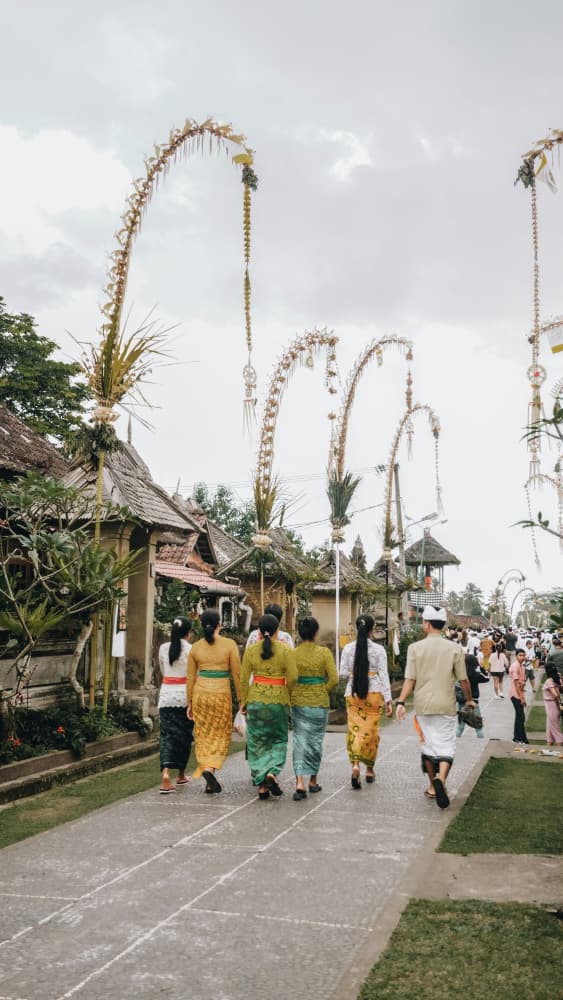
The same village that makes Galungan unforgettable makes Kuningan deeply moving. Penglipuran’s uniformly designed homes, each with its own shrine and gate, display tamiang and endongan with quiet elegance during Kuningan. Because the community maintains ancient awig-awig (customary law) governing how ceremonies are conducted, the rituals here feel genuinely unperformed — conducted for the ancestors, not for observers.
Arrive before 7 AM on June 27 to witness the peak of morning prayers.
2. Villages Around Ubud and Gianyar — Authentic Neighbourhood Ceremonies
Kuningan is fundamentally a home and community ceremony — far more intimate than Galungan’s public exuberance. The best experiences are found not at major temples but at family compounds and village shrines (pura puseh, pura desa) in traditional neighborhoods.
Villages like Mas, Peliatan, Batuan, and Sukawati — all within easy reach of Ubud — have strong ceremonial traditions and relatively few tourists on Kuningan morning. Walk slowly. Observe from a respectful distance. You will likely be invited closer.
3. Pura Besakih — The Mother Temple
Bali’s holiest temple complex, on the slopes of Mount Agung, hosts significant Kuningan ceremonies. High priests in full ceremonial dress conduct elaborate rituals as thousands of devotees arrive for final prayers of the Galungan cycle. The scale is extraordinary.
Plan for crowds, difficult parking, and a long walk. Dress impeccably. Move quietly. Hire a certified local guide who can help you navigate restricted areas and understand what you’re witnessing.
4. Denpasar’s Old Quarter — Urban Devotion
Around Pura Jagatnatha and Puri Pemecutan in central Denpasar, Kuningan ceremonies proceed with full solemnity amid the city’s ordinary sounds. There is something particularly striking about watching a woman in full ceremonial kebaya balance a tower of offerings on her head while a motorbike waits patiently behind her. Tradition and modernity, neither yielding.
5. Your Accommodation’s Neighborhood — The Hidden Best Option
If you’re staying in a family-run homestay or guesthouse (strongly recommended over resorts during Galungan-Kuningan week), step outside your gate on Kuningan morning before 8 AM. The ceremony is happening in the lane in front of you. You don’t need to go anywhere. Just be present, be respectful, and be ready to be moved.
How to Observe Kuningan Respectfully
Dress Code
- Sarong and sash: mandatory for any proximity to temples or home shrines
- Women: kebaya or modest blouse; nothing sleeveless or revealing
- Men: plain shirt with kain and udeng if you have one — locals notice and appreciate it
- Many temples offer sarong loans at the entrance, but bringing your own signals genuine respect
Photography
Ask before you photograph people. During prayers — especially the intimate morning ceremonies of Kuningan — put the camera down entirely. Some moments are not meant to be captured; they are meant to be witnessed.
Timing
If you want to experience Kuningan properly, be up and out by 7 AM. By 10 AM, the most intense prayer sequences are winding down. By noon, it is over. This is not a sunset ceremony. Kuningan belongs to the morning.
The Noon Rule
Do not ask Balinese friends or hosts to delay ceremonies for your convenience or for better photography light. The noon deadline is not negotiable — it is a core theological commitment, not a scheduling preference.
Etiquette Summary
| ✅ Do | ❌ Don’t |
|---|---|
| Wear sarong and sash | Wear shorts or sleeveless tops |
| Arrive before 8 AM | Show up after 11 AM expecting active ceremony |
| Observe quietly from periphery | Walk in front of people praying |
| Ask before photographing | Use flash during prayer |
| Step around ground offerings | Step over or touch offerings |
| Accept genuine invitations | Enter family compounds uninvited |
Kuningan vs. Galungan: Key Differences
| Galungan (June 17) | Kuningan (June 27) | |
|---|---|---|
| Meaning | Ancestors arrive; good defeats evil | Ancestors depart; gratitude and farewell |
| Mood | Celebratory, exuberant | Tender, devotional |
| Key symbol | Penjor (bamboo poles) | Tamiang, endongan, nasi kuning |
| Timing | All day | Before noon only |
| Focus | Public streets and temples | Home shrines and family compounds |
| Color | All colors | Yellow (kuning) |
The two are inseparable — Galungan without Kuningan is a welcome without a farewell. Together, they form a complete cycle of arrival, celebration, and loving release.
The Food of Kuningan
Kuningan has its own culinary signatures, some shared with Galungan week, others unique to this final day:
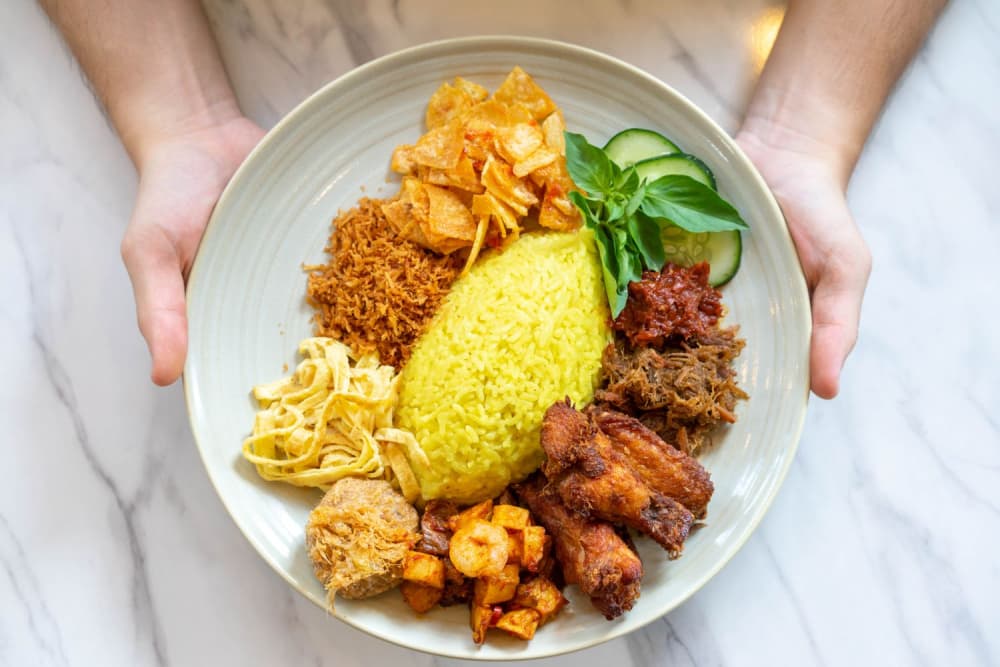
- Nasi kuning: Turmeric-yellow rice, both in offerings and on family tables
- Lawar: The communal minced meat dish prepared during Penampahan (day before Galungan) often still enjoyed through Kuningan week
- Jaje bali: Traditional sweets including klepon, laklak, and jaje uli — look for women selling these from baskets near temples in the morning
- Tape: Fermented rice or cassava, symbolizing transformation — appropriate for a day about transition
Ask your homestay host if the family will share a Kuningan meal. An invitation to eat nasi kuning at a Balinese family table on June 27 is one of the best things that can happen to a traveler in Bali.
Practical Information
Is it a public holiday? Yes. Most local businesses, markets, and warungs close or operate reduced hours on Kuningan morning. Tourist-facing restaurants and shops generally stay open. Plan accordingly — buy water and snacks the night before.
Transportation: Roads near major temples will be busier than usual in the morning. Motorbike or private driver is recommended. Getting caught behind a procession is not an inconvenience — slow down and watch.
Can tourists participate? Respectful observation is always welcome. Active participation in family shrine ceremonies is by invitation only — and genuine invitations happen regularly when visitors approach the day with evident respect and curiosity.
What about women during menstruation? Balinese Hindu custom holds that women who are menstruating should not enter temple grounds. This applies to all visitors. Many temples post notices at the gate.
Conclusion: Learning to Say Goodbye
Every culture has its ceremonies for the dead. What makes Kuningan remarkable is its emotional register: not grief, not fear, not obligation — but loving, meticulous, joyful farewell.
The Balinese do not mourn their ancestors on Kuningan. They feed them, protect them, send them off with the best provisions the family can offer, and trust that the connection — maintained through ritual, through memory, through the woven palm leaf of an endongan — remains unbroken across the distance between worlds.
On Saturday, June 27, 2026, if you find yourself in Bali before noon, standing quietly at the edge of a family ceremony, watching incense rise from a yellow-adorned shrine while a grandmother prays — you are not a tourist in that moment. You are a witness. And witnessing, done with humility and genuine attention, is its own form of respect.
Kuningan 2026: Saturday, June 27, 2026 — all ceremonies before noon. Part of the Galungan–Kuningan cycle beginning June 17, 2026. Dates confirmed by the Pawukon calendar and Parisada Hindu Dharma Indonesia (PHDI).