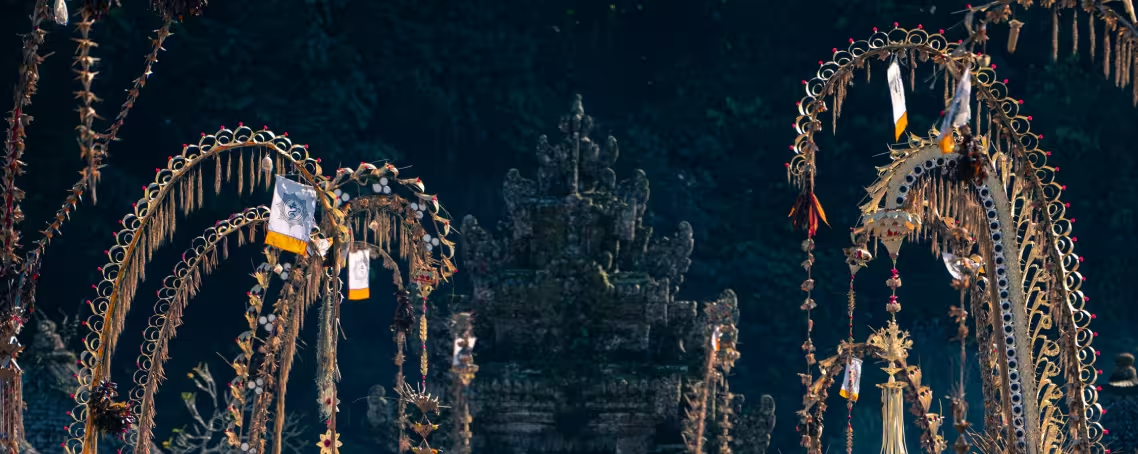
Imagine walking down a Balinese village lane at sunrise, the air thick with the scent of incense and freshly cut flowers. On either side, towering bamboo poles — each one hand-crafted and uniquely adorned — sway gently in the morning breeze. Women in white kebaya move gracefully, balancing towering towers of offerings on their heads. Children in traditional dress giggle as they follow their grandmothers toward the family temple. This is Galungan Day: not a spectacle put on for tourists, but a living, breathing expression of faith that has endured for over a thousand years.
For travelers, expats, and cultural enthusiasts visiting Bali in 2026, witnessing Galungan is one of the most profound experiences the island has to offer — if you know how to approach it with the respect and curiosity it deserves.
What Is Galungan Day? The Spiritual Significance
At its core, Galungan Day celebrates the eternal triumph of Dharma (righteousness, cosmic order) over Adharma (chaos, evil). This theme — the universe’s continual self-correction toward goodness — is not merely symbolic in Balinese Hinduism. It is lived daily, embedded in how Balinese people cook, farm, raise their children, and care for their ancestors.
During Galungan, Balinese Hindus believe that the spirits of deceased ancestors descend from the heavens to visit their families on Earth. For ten days, the veil between the living and the dead thins. Families prepare meticulously: cleaning homes, constructing elaborate offerings, and opening their family shrines (sanggah) in welcome.
This is not a somber affair. Galungan pulses with joy, color, music, and communal love. It is simultaneously a religious ceremony, a family reunion, a community festival, and a reaffirmation of Balinese identity — all woven into one.
“Galungan is the moment we remember who we are and where we come from,” said I Wayan Suardika, a pemangku (temple priest) from Ubud. “The ancestors come, and we must be ready — in our hearts and in our homes.”
Galungan 2026: Key Dates
| Event | Date | Significance |
|---|---|---|
| Penampahan Galungan | Tuesday, June 16, 2026 | Day of preparation; animals are slaughtered, offerings assembled |
| Galungan Day | Wednesday, June 17, 2026 | The main celebration; prayers, temple visits, ancestor welcome |
| Manis Galungan | Thursday, June 18, 2026 | Families visit one another; joyful socializing continues |
| Kuningan Day | Saturday, June 27, 2026 | The ancestors return to the heavens; 10-day festive period closes |
Pro tip for travelers: Arrive in Bali by June 15 to witness Penampahan preparations — markets overflow with offerings, pigs are prepared for ceremonial feasts (be prepared for this), and the entire island shifts into a different rhythm. The run-up to Galungan is as fascinating as the day itself.
The Galungan Ceremony: Rituals, Offerings, and Symbolism
Penjor — The Soul of Galungan
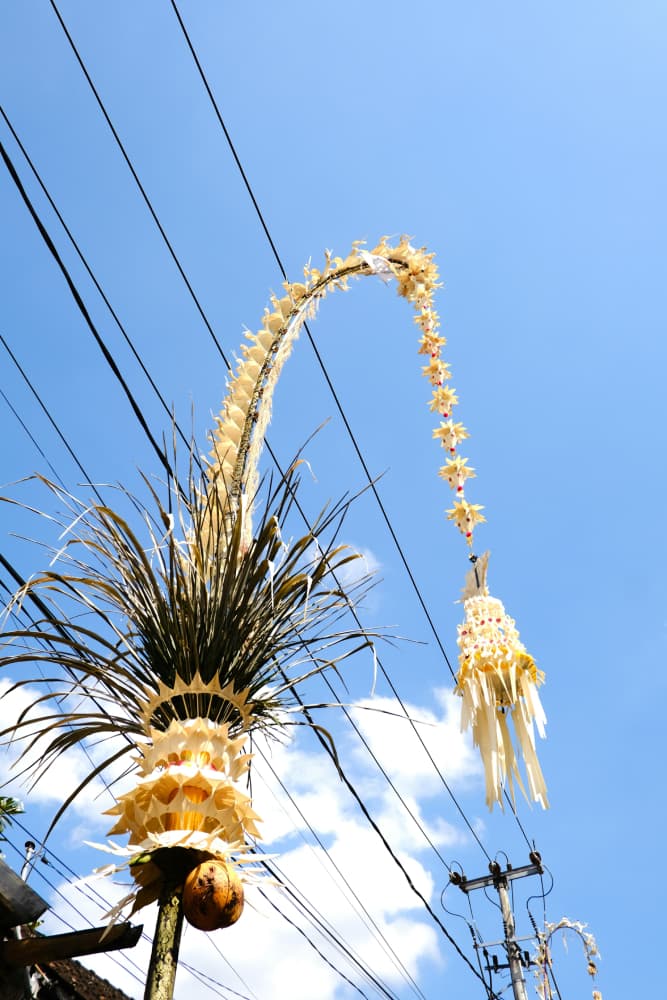
No image captures Galungan more powerfully than the penjor: a bamboo pole up to 10 meters tall, stripped of its leaves except at the very tip, then bent in an elegant arc and adorned with woven coconut leaves, fruits, rice, flowers, and a small shrine at its base.
Every penjor is unique, handmade by the family that erects it. Placed outside the family compound gate, the penjor symbolizes Mount Agung — Bali’s most sacred volcano and the home of the gods — and expresses gratitude for the harvest, health, and life itself. Walking down a Balinese street when every home has its penjor is unforgettable; it transforms ordinary village lanes into grand ceremonial corridors.
Banten — The Art of Offering
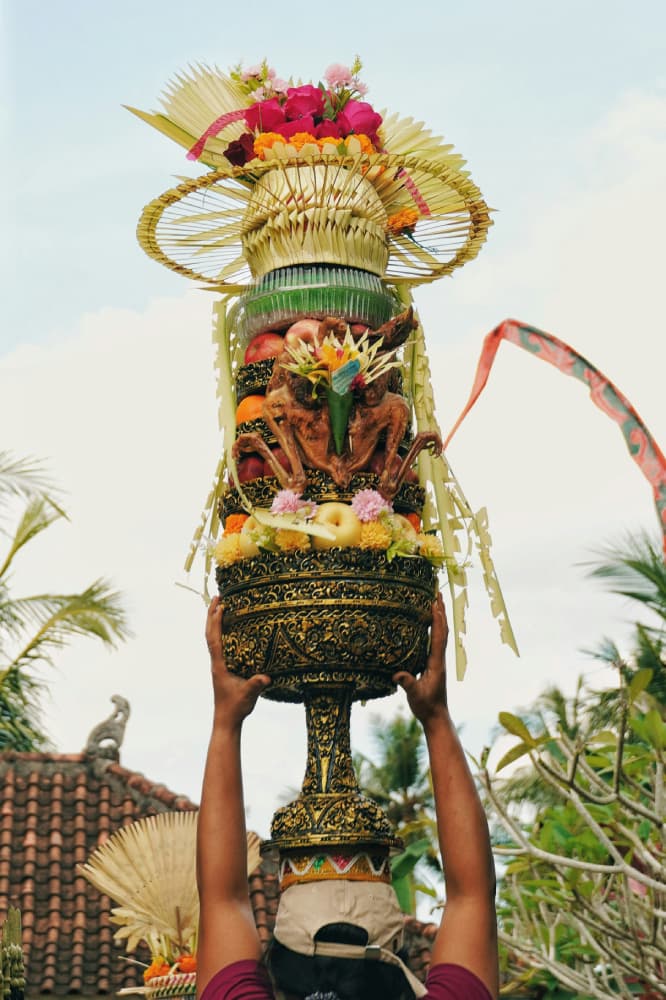
The preparation of banten (offerings) is an art form passed from mother to daughter across generations. These range from simple daily offerings (canang sari) — small palm-leaf trays holding flowers, incense, and rice — to towering ceremonial constructions that take days to assemble.
The symbolism is precise: every color, flower, and placement carries meaning. Yellow flowers represent the east (the rising sun, new beginnings). Red for the south (fire, energy). White for the west (water, purification). Blue/black for the north (air, protection). The offering is not a gift to be consumed by the gods, but a physical manifestation of gratitude and balance.
Temple Prayers and the Role of Priests
On Galungan morning, Balinese families dress in their finest traditional attire — the women in colorful kebaya and batik, the men in white shirts with a kain and udeng (head cloth) — and proceed to their family shrines and village temples for prayer.
Prayers are led by pemangku (temple priests) and, for larger ceremonies, pedanda (high priests from Brahmin caste). Chanting in Old Javanese (Kawi), the priests invoke blessings from the divine trinity of Brahma (creator), Wisnu (preserver), and Siwa (transformer), as well as the ancestral spirits now in residence.
Dance and Gamelan — When Myth Comes Alive
Galungan is one of the best occasions to witness Barong and Rangda performances — dramatizations of the cosmic battle between good and evil. The Barong (a lion-like protective spirit) and Rangda (the demon queen) engage in an elaborate, trance-inducing battle, performed by highly trained dancers.
Accompanying every ceremony is the gamelan: bronze percussion ensembles whose hypnotic, layered rhythms have been described as “the sound of Bali’s soul.” During Galungan, gamelan rings out from temples and village banjar (community halls) across the island, often late into the night.
Where to Experience Galungan 2026: An Insider’s Guide
1. Penglipuran Village, Bangli Regency — Most Atmospheric
If you visit only one place during Galungan, make it Penglipuran. This traditional village in the highlands of Bangli is famous for being one of the most preserved traditional villages in Bali, where residents still adhere to an ancient community covenant (awig-awig) governing architecture, land use, and social harmony.
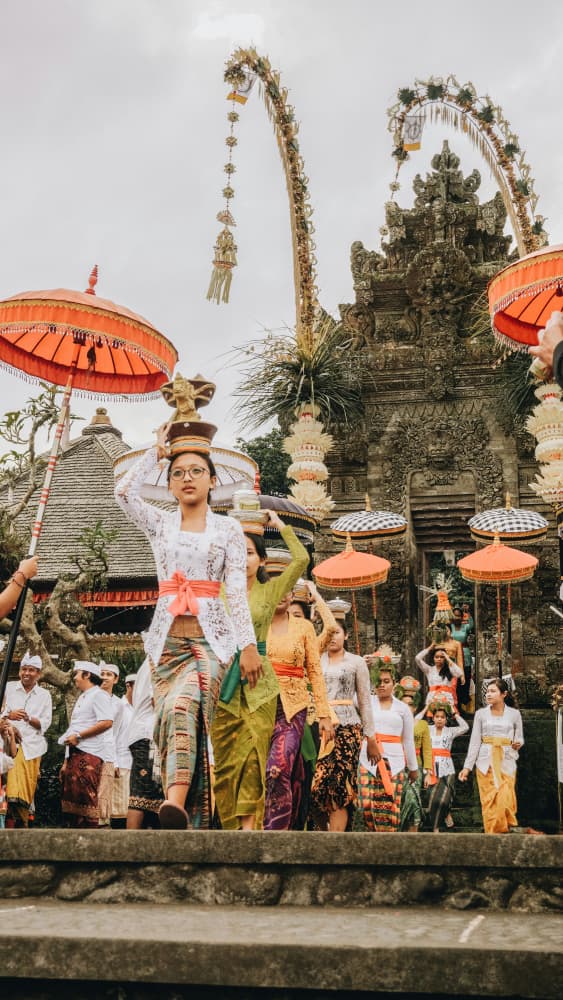
During Galungan, Penglipuran becomes breathtaking. Because every home is architecturally identical — built on the same axis, with the same gate design — the penjor lining its central lane create a perfectly symmetrical corridor of sacred decoration unlike anywhere else on the island. The community cohesion here means Galungan feels genuinely communal, not performative.
Practical tip: Arrive early (before 8 AM) to see families heading to prayers. The light is also better for photography.
2. Ubud — Cultural Heart of Bali
Ubud’s dense concentration of temples, art communities, and cultural organizations makes it an excellent base for Galungan. The town’s famous Puri Saren palace often hosts traditional performances in the evenings. Surrounding villages like Mas, Peliatan, and Pengosekan have strong artistic traditions and offer accessible, authentic ceremony observation.
Ubud’s weekly markets transform during Galungan week: look for elaborate banten sold by women from Sukawati, and jajan (traditional Balinese sweets) that appear only during this period.
3. Besakih Temple — The Spiritual Apex
Pura Besakih, perched at 1,000 meters on the slopes of Mount Agung, is Bali’s holiest temple complex — a series of 23 related temples that together form the “Mother Temple” of the island. During Galungan, Besakih hosts some of the island’s most significant ceremonies, conducted by high priests in elaborate ritual garments.
Going to Besakih on Galungan itself requires planning: it is crowded, parking is challenging, and the experience can feel overwhelming. But if approached with patience and proper attire, there is nothing quite like witnessing thousands of Balinese Hindus in prayer against the backdrop of Agung’s volcanic slopes disappearing into cloud.
Important: Only enter areas clearly marked as open to non-Hindu visitors. Hire a certified, reputable guide who can help you navigate the complex without accidentally intruding on restricted ceremonies.
4. Denpasar — Tradition in the City
Bali’s capital offers a fascinating counterpoint to rural celebrations. In Denpasar’s old neighborhoods — around Puri Pemecutan and Pura Jagatnatha — Galungan ceremonies proceed with full solemnity amid the sounds of motorbikes and city life. Seeing ancient ritual persist in an urban context underscores just how deeply Galungan is embedded in Balinese identity, not dependent on a “traditional” setting to survive.
5. Your Neighborhood — The Best Seat in the House
Honestly, some of the most moving Galungan experiences are completely unplanned: stumbling upon a family procession in your villa’s lane, being invited to observe offerings at a neighbor’s home shrine, or simply sitting at a warung as the village goes past in ceremonial dress. Stay somewhere local. A family-run guesthouse (homestay) rather than a resort will place you inside Galungan rather than outside looking in.
How to Participate Respectfully: The Essential Guide
Balinese people are extraordinarily welcoming to visitors who show genuine respect. Here’s how to be that visitor.
Dress Code — Non-Negotiable
For temple visits and any proximity to ceremonies:
- Sarong (wraparound skirt): required for entry to all temples; many temples provide loaners at the gate, but bringing your own is respectful
- Sash (selendang): tied around the waist over the sarong, symbolizing spiritual readiness
- Women: a kebaya blouse is ideal; any modest, non-revealing top works
- Men: a plain shirt or baju; traditional udeng headcloth earns immediate warmth from locals
Do not visit temples in shorts, sleeveless tops, or beachwear, regardless of the heat.
Photography — Ask First, Shoot Second
The Balinese are not camera-shy, but there is a difference between photographing a festive street scene and pointing a lens at someone deep in prayer. Always ask permission before photographing individuals. During active prayer sequences, lower your camera entirely. A good rule: if you wouldn’t do it in your own place of worship, don’t do it here.
Drone photography near temples and during ceremonies is almost universally inappropriate and may violate local regulations.
Offerings — Look, Never Touch
The banten placed at gates, intersections, and temple steps are sacred objects. They are not decorations, and they are not props. Do not touch, step over, or rearrange offerings. If you find an offering blocking a doorway, wait for someone to move it or find another way around.
Temple Menstruation Policy
Balinese Hindu custom holds that women who are menstruating should not enter temple grounds during that time, as this period is considered ritually impure (sebel). This applies to all women, including visitors. Many temples post notices at the gate.
Engage Curiously, Not Extractively
If a family invites you to watch their home ceremony (and they often will — Balinese hospitality is genuine), come as a learner. Ask questions afterward, not during. Bring a small gift if appropriate (fruit, packaged snacks). Do not treat the ceremony as content for social media to be narrated in real time.
What to Avoid
- Alcohol and smoking near temples or active ceremonies
- Loud conversation or laughter during prayers
- Turning your back to shrines when leaving a temple
- Pointing your feet toward altars or sacred objects (in Balinese Hindu tradition, feet are the lowest, least sacred part of the body)
The Galungan Kitchen: Food, Flavor, and Ritual
Galungan has its own culinary culture. The day before (Penampahan) involves the ritual preparation of the lawar feast — a complex dish of minced meat, vegetables, grated coconut, and spices, with different households having their own jealously guarded recipes. Traditionally made communally by the men of the banjar, lawar preparation is its own ceremony.
Look out for:
- Lawar merah (red lawar, made with pork blood) and lawar putih (white, without blood)
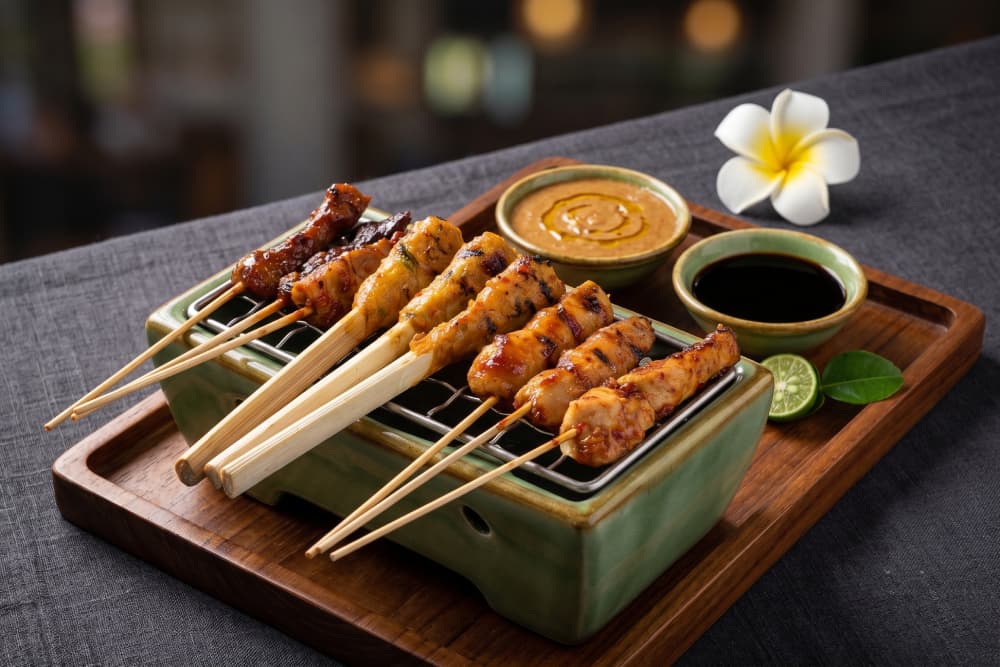
- Sate lembat — minced meat satay mixed with spices and coconut, grilled over coconut husk
- Nasi bali — a ceremonial rice dish with multiple small accompaniments
- Jajan bali — traditional sweets including klepon (rice balls with palm sugar), laklak (small green pancakes), and jaje uli (sticky rice cakes)
Many warungs and family restaurants in Bali offer special Galungan menus. Ask your host or guesthouse owner where to find authentic preparations.
Practical Planning: Visiting Bali for Galungan 2026
Accommodation
Book well in advance. The Galungan-Kuningan period (June 17–27, 2026) sees significant domestic tourism as Balinese families travel across the island to attend ceremonies in their ancestral villages. Hotels and villas in Ubud and Kuta fill up quickly.
Recommendation: Stay in a family-run homestay in or near a traditional village — Penglipuran, Sidemen, Tegallalang, or the villages around Ubud. This gives you immersive access and local guidance.
Getting Around
Rent a scooter or hire a private driver for maximum flexibility during Galungan week. Many roads near major temples will be congested on June 17. Plan around temple processions rather than against them — getting caught behind a procession of 200 people in ceremonial dress, gamelan playing, is not a problem. It’s the point.
Etiquette Summary Card
| ✅ Do | ❌ Don’t |
|---|---|
| Wear sarong and sash at temples | Wear shorts or sleeveless tops |
| Ask before photographing people | Photograph during active prayers |
| Observe ceremonies quietly | Talk loudly or use your phone |
| Accept invitations graciously | Touch or move offerings |
| Bring small gifts to hosts | Drink alcohol near sacred spaces |
| Hire a knowledgeable local guide | Enter restricted temple areas |
Frequently Asked Questions
Can tourists attend temple ceremonies during Galungan? Yes, most temples welcome respectful visitors. Bring your own sarong and sash, approach quietly, and follow the lead of those around you. Some inner sanctuaries are restricted to Hindu worshippers — respect these boundaries without question.
Is Galungan a public holiday in Bali? Yes. Many businesses, shops, and services operate on reduced hours during Galungan Day itself (June 17) and Kuningan (June 27). ATMs may run out of cash. Stock up on essentials the day before.
Can I give offerings? If you are invited to participate by your Balinese hosts, yes — follow their guidance exactly. Do not purchase and place offerings independently without being shown how, as improper placement or preparation can be seen as disrespectful.
What if I’m not Hindu? Galungan is a Hindu ceremony, but Balinese Hindus generally welcome respectful observers of all faiths and none. Your religious background is irrelevant; your intention and behavior are what matter.
Conclusion: More Than a Spectacle
Galungan is not a festival designed for visitors. It was not created for photographs, itineraries, or bucket lists. It exists because the Balinese people have, for over a thousand years, chosen to pause their ordinary lives, remember their ancestors, reaffirm their values, and celebrate the fact that goodness — however hard-pressed — always prevails.
When you stand on a Balinese lane on the morning of June 17, 2026, watching a grandmother place a hand-woven offering at the base of her family’s penjor, you are not watching history. You are watching a living civilization maintain itself with grace, beauty, and profound intention.
Come with curiosity. Come with respect. Come ready to be moved.
Galungan 2026 falls on Wednesday, June 17, 2026. The festive period concludes with Kuningan on Saturday, June 27, 2026.
For temple etiquette updates and local ceremony schedules, consult the Bali Tourism Board or your accommodation’s local staff upon arrival.