Every July, a sacred wind sweeps across the shores of Sanur. It bends the palms, ripples the sea, and lifts something enormous and magnificent into the sky. This is not just any wind — to the Balinese, it is an invitation. An invitation to send a message upward, through silk and bamboo and prayer, straight to the gods.
Welcome to the 5th Bali Kite Festival 2026.
“Yadnya Cakra”: Where Offering Meets Art
This year’s festival carries a name that resonates deeply with the Balinese soul: Yadnya Cakra — a Sanskrit-rooted phrase meaning the wheel of sacred offering. Paired with the theme “Kreativitas Tiada Henti” (Creativity Without End), the 2026 edition signals more than a competition. It is a declaration: that tradition does not stand still, it spirals upward, like a kite climbing into the heavens, carrying with it the accumulated faith and artistry of generations.
Organized by the Komunitas Seni Layangan Bali (Bali Kite Art Community), this landmark fifth edition promises to be the most vibrant chapter yet in what has become one of Southeast Asia’s most extraordinary cultural events.
Mark Your Calendar
📍 Pantai Mertasari, Sanur — Bali 📅 Saturday & Sunday, July 18–19, 2026
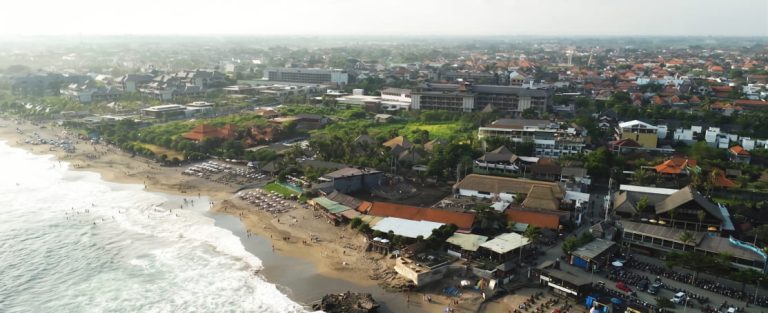
Mertasari Beach in Sanur was not chosen by accident. Its wide-open shoreline offers an unobstructed corridor of sea breeze — the very wind these colossal kites hunger for. Arrive early. The skies fill fast, and the best views belong to those who plant their feet in the sand before the first Gamelan note rings out.
More Than a Festival: A Living Prayer
Long before it was a spectacle, the Bali Kite Festival was a ritual. Rooted in Bali’s Hindu agricultural traditions, the flying of kites was — and remains — an act of devotion. The kites soar as divine messengers, carrying the gratitude of the Balinese people to Rare Angon, the god of agriculture, and to the heavens above, offering thanks for a bountiful harvest and prayers for the seasons to come.
What makes this festival unlike any other in the world is precisely this duality: it is simultaneously a deeply spiritual ceremony and a breathtaking public event. The faithful and the curious stand side by side on the same stretch of sand, all looking up, all moved by the same sight.
The Giants of the Sky
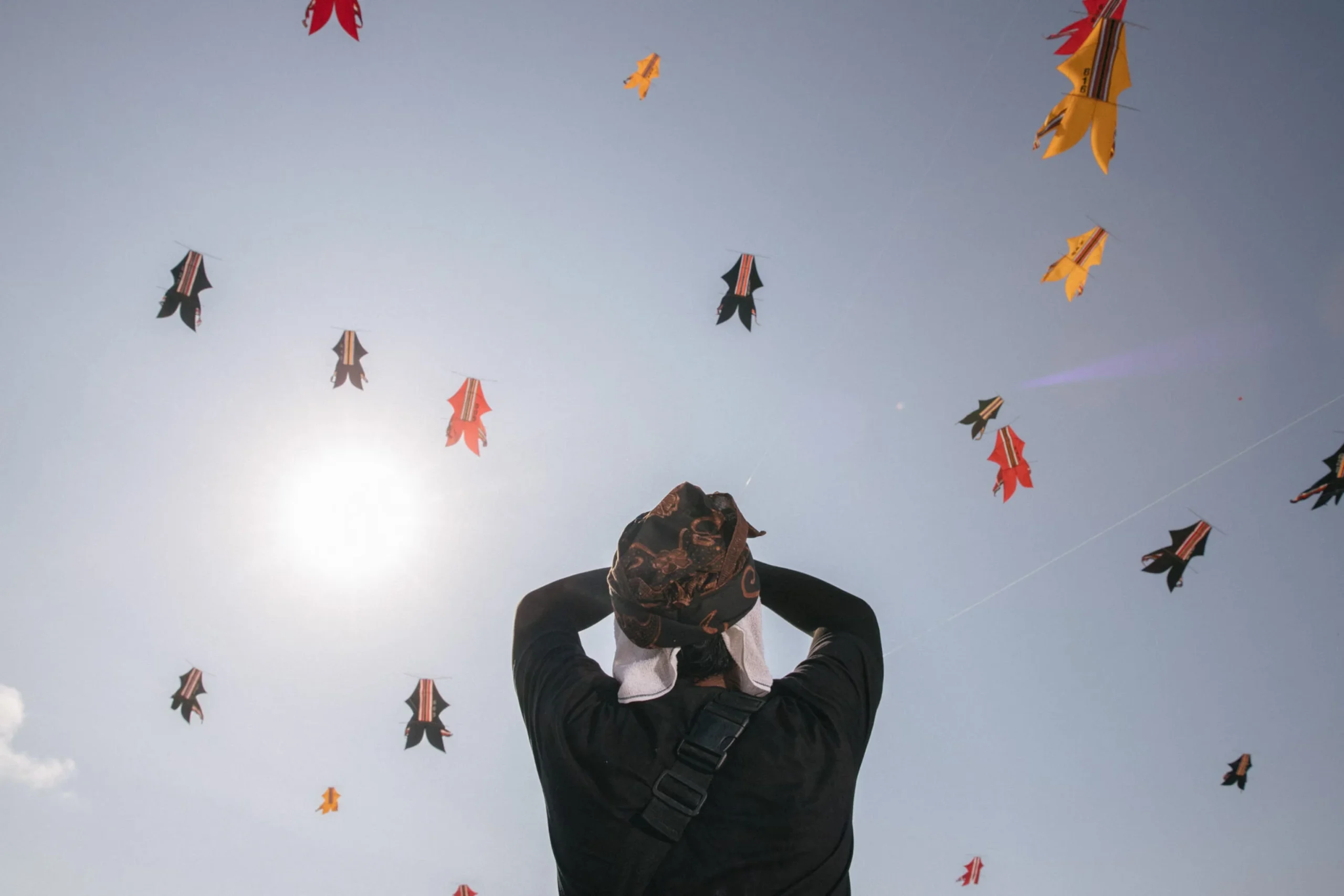
Prepare yourself. These are not the kites of childhood. Traditional competition kites at the Bali Kite Festival are architectural achievements — structures that can measure four meters wide and ten meters long, requiring teams of 70 to 80 people from each local village council (banjar) to launch and control. Each team arrives with its own Gamelan orchestra, whose rhythmic percussion forms the heartbeat of the event, and flag bearers who transform each team’s procession into a moving ceremony.
Three classical forms dominate the competition sky:
Bebean — The Ocean Spirit
Shaped like a broad-mouthed fish, the Bebean is the festival’s most iconic silhouette — wide, commanding, and immediately recognizable as it cuts through the coastal wind. It is often the largest entry in the sky and a symbol of abundance drawn from both sea and field.

Janggan — The Dragon-Bird
The most dramatic of all, the Janggan marries the body of a mythical bird with the fierce crowned head of a dragon. Its defining feature is a ribbon tail that can stretch beyond 100 meters, undulating and cascading in the wind in an almost hypnotic display. To watch a Janggan ride a strong gust is to understand why the Balinese see the sky as sacred.

Pecukan — The Leaf
Deceptively simple in shape, the Pecukan is considered the most technically demanding kite to fly. Its leaf-like form is inherently unstable, and keeping it airborne requires a mastery of wind, tension, and teamwork that only the most experienced teams can achieve. Victory with a Pecukan is a victory of pure skill.

Kreasi Baru — New Creation
Beyond the traditional forms, the New Creation category is where imagination is unleashed. Teams craft kites depicting Hindu deities, mythological epics, abstract forms, and contemporary designs — a testament to the festival’s theme: creativity without end. This category has become a showcase for Bali’s next generation of artisans, pushing the boundaries of what a kite can be.
Competing for the Governor’s Cup
At the heart of the festival beats the spirit of competition. Teams from across Bali vie for the prestigious Governor of Bali’s Cup, judged on flight performance, artistic craftsmanship, and the coordination of the supporting procession. The stakes are high, the rivalry fierce — but always conducted in the spirit of menyama braya, the Balinese ethos of brotherhood and togetherness.
With over 130 teams registered in previous editions, the 2026 festival is expected to draw an even greater number of participants, making the skies above Mertasari more crowded, colorful, and competitive than ever before.
Preserving a Legacy, Inspiring a Generation
Behind every kite that rises above Sanur is a story of devotion — not just to the gods, but to the craft itself. The Komunitas Seni Layangan Bali has, since the festival’s inception, maintained a clear and urgent mission: to ensure that the art of kite-making and kite-flying does not fade from Bali’s cultural memory.
Gede Lanang Darma Wiweka — affectionately known as Mr. Botax, the festival committee chairman — has been the driving force behind this mission. “The main goal of this festival is not just the competition,” he has said, “but to preserve the art and culture of Bali, especially the art of making and flying kites.” For Mr. Botax and his community, each festival is an act of cultural preservation as much as it is a celebration.
This vision is shared at the highest levels of Balinese governance. The Governor of Bali has consistently championed the festival as a symbol of the island’s enduring cultural identity — proof that tradition and modernity can rise together, as naturally as a kite on a July wind.
Why You Must Be There
There are events you attend, and there are events that stay with you. The Bali Kite Festival belongs to the second category. The sight of a 10-meter Janggan tail streaming across a blue Balinese sky while a Gamelan ensemble plays below, surrounded by hundreds of devotees, competitors, and wide-eyed travelers — it is the kind of moment that makes you feel, briefly but completely, like you understand something essential about humanity.
The 5th Bali Kite Festival — Yadnya Cakra is not a tourist attraction. It is a living, breathing expression of a culture that has chosen, year after year, to look upward. To send its gratitude into the sky. To let its creativity have no end.
Mertasari Beach, Sanur. July 18 & 19, 2026.
Be there.